


Author: Bob Brensel | President, Pharmacist | ScriptWorks
Bob Brensel, RPh, earned his Pharmacy Degree at University of the Pacific in Stockton, California in 1980. Former California Pharmacists Association’s Award Winner for Recognition of Outstanding Achievement in Compounding Pharmacy. Read More →
Estimated Read Time: 9–10 minutes
Blog Summary:
This guide explores how the NasoNeb® Sinus Therapy System works and why delivery method plays a key role in provider-guided sinus care. It explains how nebulized mist may differ from traditional sprays and rinses, outlines how the device is used, and highlights when clinicians may consider this approach. The article also covers how ScriptWorks Pharmacy supports customized, prescriber-directed sinus therapies using compounded formulations tailored to individual patient needs.
Important Note:
The device is a delivery system and does not determine clinical outcomes, which remain dependent on provider-directed care.
California Sinus Care and the NasoNeb Nebulizer
Many Californians managing chronic sinus concerns already understand one thing: what you use matters. Equally important, how it’s delivered may shape the overall experience.
In simple terms:
How a sinus solution is delivered may be just as important as what is being used.
Today’s sinus care options include nasal sprays, rinses, and irrigation systems. All aim to support comfort. However, they don’t move solutions through the nasal passages in the same way. As a result, coverage and consistency can vary based on the delivery method and individual nose anatomy.
To address this, experts developed the NasoNeb Sinus Therapy System. Available through ScriptWorks Pharmacy, this powered sinus therapy device uses fine-mist dispersion designed to support more even distribution within the nasal and sinus passages — under provider guidance.
Understanding the NasoNeb Sinus Therapy System for Sinus Care
NasoNeb Nebulizer: Quick Answers
What is the NasoNeb nebulizer?
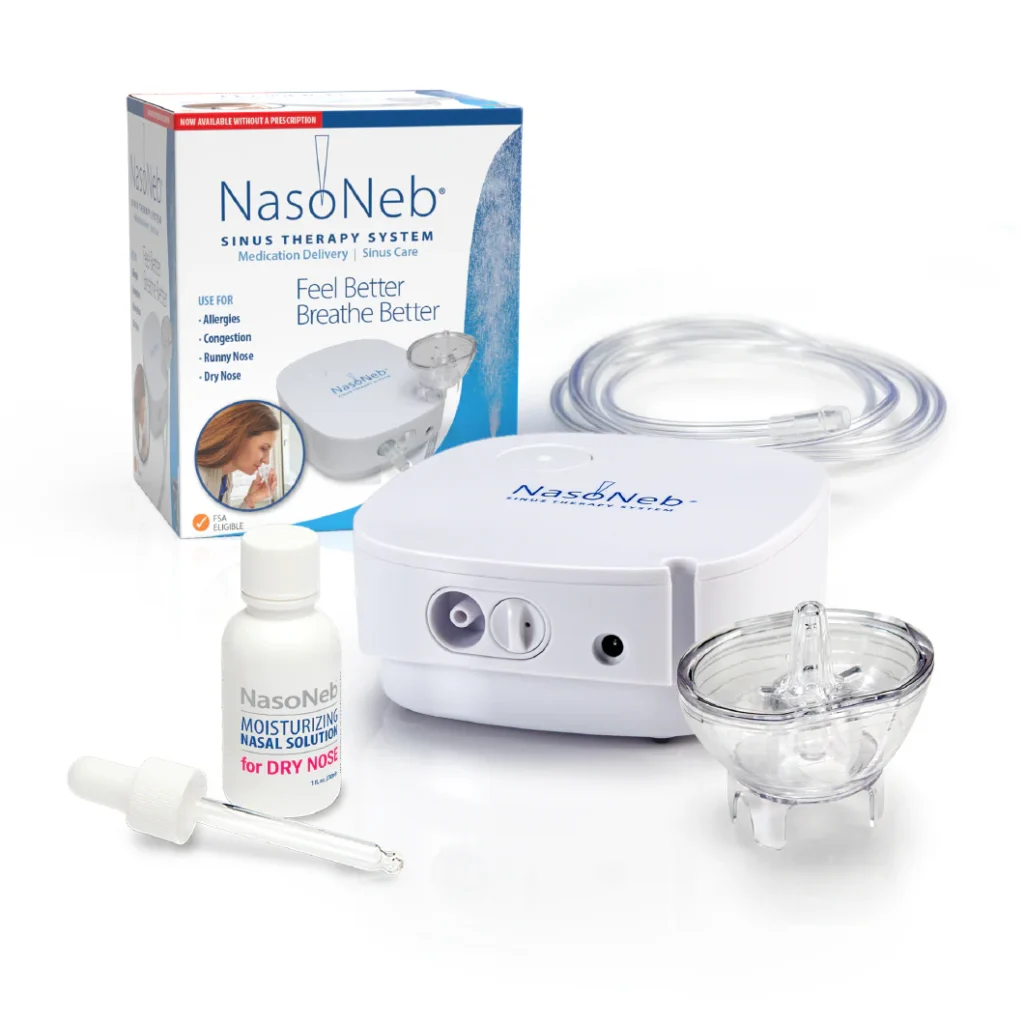
The NasoNeb® Sinus Therapy System is a powered nasal nebulizer designed to deliver solutions as a fine mist into the nasal and sinus passages. Unlike traditional sprays or rinses, it uses airflow to disperse liquid during normal breathing. It is typically used as part of a provider-directed sinus care plan.
What makes this different:
NasoNeb delivers solutions as a mist using airflow, rather than relying on liquid flow or spray pressure.
How does Nasoneb work?
The NasoNeb system is a nasal nebulizer for sinus care that uses a small compressor to convert liquid into a fine mist. This mist is introduced into the nasal passages through a nozzle while the user breathes normally. This delivery approach is designed to distribute solutions differently than gravity-based rinses or spray pumps.
In practice:
The device delivers a continuous mist while the user breathes, rather than pushing liquid through the nasal passages.
Have questions about NasoNeb delivery options and compounded sinus therapies?
Ask a pharmacist for guidance based on your provider’s recommendations.
Who may benefit?
Providers may consider this delivery method for individuals who have difficulty using traditional sprays or rinses, or when delivery approach is an important factor in care planning. It may also be discussed in situations involving anatomical differences, post-surgical considerations, or sensitivity to certain delivery techniques. Use is always based on prescriber evaluation and individual patient needs.
To clarify, this places the device in a different category than:
- Standard nasal sprays, which deliver a small, localized amount
- Neti pots or squeeze bottles, which depend on liquid flow and drainage
In contrast, nebulized mist delivery disperses solutions more gently throughout the nasal passages. As a result, many providers view systems like NasoNeb as a distinct option within broader nasal irrigation approaches.
Key Takeaways:
- The NasoNeb sinus therapy system is a powered nasal nebulizer for sinus care
- It uses airflow instead of manual pressure or gravity
- It delivers solutions as a fine mist during normal breathing
- It differs from both sprays and traditional irrigation methods
What’s Included in the NasoNeb Therapy System
The NasoNeb machine includes the following components:
- Compressor
- Nebulizer cup and tubing set
- 30-mL bottle of NasoNeb moisturizing nasal solution
- Five replacement filters
Together, these parts support powered mist delivery for nasal and sinus care. In particular, the system may be helpful for individuals who find traditional rinses or spray pumps difficult to use. However, use of the device and any solutions should always follow prescriber guidance, based on clinical goals and individual needs.
How the NasoNeb Nebulizer System Works
The NasoNeb system uses a small compressor, tubing, and a nebulizer cup to generate airflow. When activated, it converts liquid into a fine mist that enters the nasal passages during normal breathing.
Why this approach is different:
Mist-based delivery introduces solutions without relying on fluid flow or drainage.
Instead of draining quickly, the mist is designed to coat nasal surfaces more evenly. It is designed to reach areas that may be harder to access with sprays or gravity-based rinses alone.
This delivery approach is designed intentionally, not incidental.
Computational modeling research has examined how nebulized mist delivery compares with traditional nasal irrigation under simulated conditions. Using computational fluid dynamics (CFD), researchers modeled how different delivery methods distribute solutions within the sinonasal anatomy, including post-surgical structures.
In these simulations, nebulized delivery demonstrated different deposition patterns in deeper sinus regions compared with bottle-based irrigation methods. These findings explain why researchers study powered nebulization.
How NasoNeb Works:
- A compressor generates airflow
- Liquid is converted into a fine mist
- The mist is delivered through a nasal nozzle
- Users breathe normally during administration
“These findings emphasise the importance of adapting drug delivery strategies to specific surgical and anatomical factors. Tailored post-operative protocols may enhance outcomes in CRS, potentially improving patient comfort and compliance, and reducing recurrence rates.”
- Pourmehran et al., 2025, Computer Methods and Programs in Biomedicine
Because different organs may be affected, clinical signs can vary widely. Neurologic symptoms, behavioral changes, or progressive weight loss may occur in some cats.
Sinus Nebulizer vs Neti Pot: What’s the Difference?
When comparing a sinus nebulizer vs neti pot, the primary difference is how solutions are delivered through the nasal passages. While both approaches are used in sinus care, they rely on very different mechanisms to introduce solutions into the sinonasal anatomy.
Key distinction:
A neti pot moves liquid through the nose, while a sinus nebulizer disperses a mist within it.
Neti pots and squeeze bottles use a gravity-based method. Liquid flows from one nostril to the other, depending on head positioning and steady pouring or pressure. This approach has been widely used and may be familiar to many individuals managing routine sinus care.
In contrast, a sinus nebulizer — such as the NasoNeb sinus therapy system — uses airflow to create a fine mist. This mist is introduced into the nasal passages while the user breathes naturally rather than relying on fluid flow or drainage. Because of this, the overall delivery experience and distribution pattern may differ.
Key Differences Between a Sinus Nebulizer and a Neti Pot
- Delivery Method
Neti pot: Gravity-based liquid flow
Sinus nebulizer: Airflow-generated fine mist - User Technique
Neti pot: Requires head positioning and controlled pouring
Sinus nebulizer: Used during normal breathing with minimal positioning - Solution Movement
Neti pot: Liquid passes through nasal passages and drains out
Sinus nebulizer: Mist disperses within the nasal cavity - Experience Considerations
Neti pot: May feel more like a rinse or flush
Sinus nebulizer: May feel lighter due to mist-based delivery
Because each method introduces solutions differently, providers may consider these approaches based on patient preference, anatomy, and overall care goals. In some cases, the discussion may focus less on the solution itself and more on how it is delivered.
Comparison of Nasal Delivery Options
| Feature | Nasal Spray | Neti Pot / Rinse | Sinus Nebulizer (NasoNeb) |
|---|---|---|---|
| Delivery Method | Pump spray | Gravity-based flow | Airflow-generated mist |
| Coverage Area | Localized | Flows through passages | Dispersed mist within nasal cavity |
| User Technique | Simple spray | Requires head positioning | Used during normal breathing |
| Solution Movement | Stays near spray site | Enters and drains out | Mist disperses without forced drainage |
| Experience | Quick, targeted | Rinse/flush sensation | Lighter mist-based delivery |
| Provider Considerations | Local application | Full passage rinse | Alternative delivery approach |
Why Delivery Method Matters in Sinus Care
When discussing sinus care, the focus often starts with the solution itself. However, how that solution is delivered may play an equally important role in the overall approach.
In context:
Delivery method may influence not only how solutions are introduced, but also how consistently they are used over time.
Different delivery methods introduce solutions into the nasal passages in distinct ways. For example, sprays typically provide localized application, while gravity-based rinses rely on fluid flow and positioning.
In some cases, factors such as nasal structure, prior sinus surgery, or sensitivity to certain techniques can influence how effectively a delivery method is tolerated or used consistently. When consistency or coverage becomes a concern, the conversation may shift from what is being used to how it is being delivered.
Mist-based systems like the NasoNeb® sinus therapy system are sometimes described as nebulized sinus therapy. By using airflow to disperse a fine mist during normal breathing, these systems are designed to introduce solutions differently than sprays or gravity-dependent rinses.
Importantly, no single delivery method is universally appropriate. Instead, providers evaluate patient-specific factors, goals, and practical considerations when selecting how a solution is introduced into the nasal passages.
In this context, the delivery method isn’t a secondary detail — it’s one component of a coordinated, provider-guided sinus care plan
Why Delivery Method Matters:
- Different methods distribute solutions in different ways
- Anatomy and prior procedures may influence delivery
- Comfort and ease of use can affect consistency
- Providers may evaluate delivery approach alongside formulation
NasoNeb Instructions: How the Device Is Used
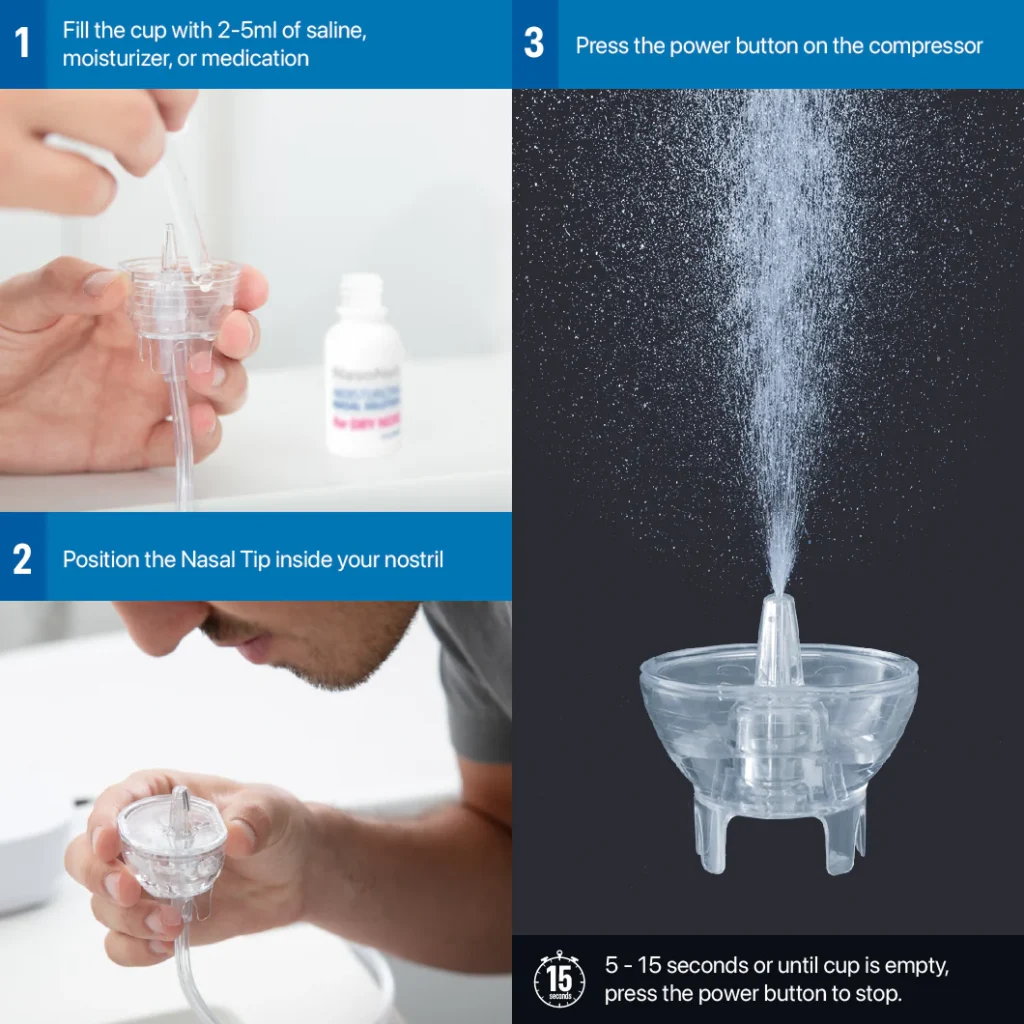
NasoNeb® directions are generally straightforward. However, the specific solution, preparation method, and frequency of use should always follow prescriber guidance.
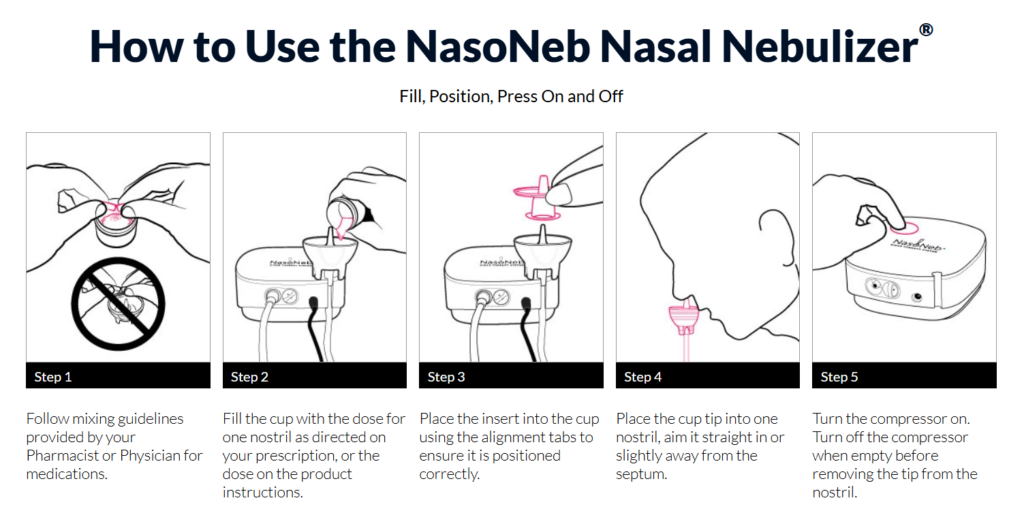
To begin, place the NasoNeb machine on a flat surface and connect the tubing between the compressor and nebulizer cup. Prepare the provider-prescribed solution and add it to the cup. In some cases, compounded medication capsule contents may be dissolved into saline prior to use, depending on the prescribed formulation.
During NasoNeb® use, individuals typically:
- Tilt the head slightly downward and insert the nozzle into one nostril
- Turn on the compressor while breathing through both the nose and mouth, keeping the palate open
- Allow the device to deliver a fine mist into the nasal passages during normal breathing
When about half of the solution has been used — often around one minute — the compressor is turned off. The remaining solution is then added, and the process is repeated for the other nostril.
Some providers recommend starting with saline alone before introducing compounded medications. This allows individuals to become familiar with the device and observe how their nasal passages respond.
During early use, mild irritation or light nasal bleeding may occasionally occur as tissues adjust. Providers may suggest adjusting the formulation or introducing it gradually if needed.
After each session, clean the nebulizer cup with warm soapy water. If moisture enters the tubing, briefly run the compressor with the cup removed to help clear it.
Sessions are typically brief, though frequency and solution type are always determined by the prescribing clinician.
ScriptWorks Compounding Support for NasoNeb Sinus Therapy
At ScriptWorks, personalized sinus care often begins with formulation flexibility. Rather than relying solely on standard, one-size-fits-all products, prescribers can work with our pharmacists to prepare customized therapies designed for localized nasal or sinus delivery.
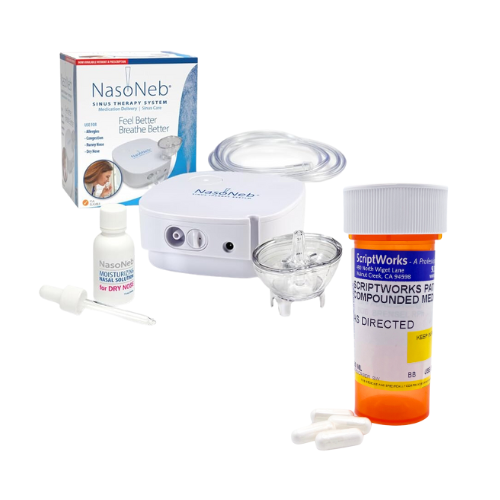
When delivery systems such as the NasoNeb Sinus Therapy System are used, the clinician selects the medication while the pharmacy prepares the formulation according to those instructions. This collaborative approach allows therapy selection to reflect patient anatomy, sensitivities, and clinical considerations.
In some prescribing workflows, compounded sinus medications may be prepared in capsule form and dissolved into saline prior to use, depending on the formulation and the delivery system selected by the prescriber. This preparation approach allows medications to be introduced into irrigation or nebulized delivery systems when appropriate.
ScriptWorks compounds a wide range of medications that prescribers may incorporate into sinonasal care strategies. Examples of medications that may be prepared for provider-directed nasal or sinus delivery include:
Corticosteroids
- Budesonide
- Mometasone
- Betamethasone
Antifungal Agents
- Amphotericin
- Fluconazole
- Itraconazole
Topical Antibiotics
- Amikacin
- Ciprofloxacin
- Clindamycin
- Gentamicin
- Levofloxacin
- Mupirocin
- Tobramycin
- Vancomycin
Adjunct or Specialty Agents
- Acetylcysteine
- EDTA (chelating agent)
- SMZ-TMP
These examples reflect medications our pharmacists may compound based on prescriber-specified formulations, concentrations, and delivery preferences. The selection of any medication depends entirely on prescriber evaluation and patient-specific considerations.
Compounded formulations may be prepared for several sinonasal delivery approaches, including sprays, irrigation systems, or nebulized mist. When nebulization is selected, powered devices such as the NasoNeb nebulizer may be used to deliver the compounded solution.
Our pharmacists coordinate closely with providers to help ensure compounded preparations align with the intended delivery system and overall care plan.
When Prescribers May Recommend NasoNeb
When providers consider sinus care options, the conversation often begins with the concern being managed rather than the device itself. Delivery method becomes relevant when it may influence how solutions are introduced into the nasal cavity.
These discussions may arise in clinical situations such as:
- Seasonal allergens in California
- Chronic sinus congestion
- Nasal dryness or irritation
- Post-sinus surgery care
From there, conversations often focus on practical challenges, anatomy, and individual sensitivities. The following scenarios illustrate how delivery methods may enter provider-patient discussions.
Difficulty Using Bottles or Neti Pots
- What’s Happening: Some patients find gravity-based rinses uncomfortable or hard to manage. Squeezing bottles, head positioning, or controlling fluid flow can become barriers to consistent use.
- How Providers May Approach It: A provider may explore delivery options that do not rely on force or positioning, especially when technique affects day-to-day use.
- Why Delivery Method Matters: Mist-based dispersion offers an alternative way to introduce solutions into the nasal passages without manual pressure.
Reassessing Care After Standard Approaches
- What’s Happening: Patients may report having tried sprays or rinses but still feel limited by how solutions are distributed.
- How Providers May Approach It: Rather than changing ingredients, a prescriber may revisit how solutions are delivered.
- Why Delivery Method Matters: Different delivery mechanisms can influence where solutions travel within the nasal and sinus anatomy.
Post-Sinus Surgery Considerations
- What’s Happening: After sinus surgery, anatomical changes can affect fluid flow and access to certain sinus regions.
- How Providers May Approach It: ENT specialists may consider delivery methods studied in post-surgical models when discussing ongoing care.
- Why Delivery Method Matters: Air-driven mist may distribute differently than gravity-based rinses in surgically altered anatomy.
Sensitivity to Common Ingredients
- What’s Happening: Some patients experience irritation or intolerance to standard over-the-counter formulations.
- How Providers May Approach It: A prescriber may discuss simplified base solutions or customized compounded options.
- Why Delivery Method Matters: Delivery systems that support individualized formulations allow providers to tailor care more precisely.
Hard-to-Reach Nasal or Sinus Areas
- What’s Happening: Anatomical variation or prior procedures can make certain areas less accessible with localized sprays.
- How Providers May Approach It: Rhinologists may evaluate whether a broader dispersion pattern better aligns with the patient’s anatomy.
- Why Delivery Method Matters: Nebulized mist is studied as a distinct approach to solution distribution within the sinonasal passages.
Balancing Routine and Consistency
- What’s Happening: Even motivated patients can struggle to maintain complex sinus care routines.
- How Providers May Approach It: Ease of use and daily practicality may become part of the discussion when selecting a delivery method.
- Why Delivery Method Matters: Systems that fit more naturally into daily habits may support more consistent use over time.
Although delivery method is only one part of the sinus care conversation, nasal irrigation itself has been widely studied as supportive care. A systematic review on chronic rhinosinusitis found that saline irrigation is commonly used in sinus management. Within this framework, providers may select different delivery systems based on unique patient scenarios and medications.
“At the end of three months of treatment, patients in the saline group were better than those in the placebo group and at six months there was a greater effect.”
- Chong et al., 2016, Cochrane Database of Systematic Reviews
How ScriptWorks Supports NasoNeb as Part of Clinician-Directed Care
At ScriptWorks, we’re a PCAB-accredited compounding pharmacy with deep experience supporting personalized care. We work closely with prescribers and patients to help ensure that devices like NasoNeb fit thoughtfully within an individualized management plan.
That partnership means NasoNeb isn’t positioned as a standalone device. Instead, it’s supported through pharmacy guidance that aligns with your provider’s recommendations and your specific needs.
Why California Providers Trust ScriptWorks Compounding Pharmacy
- Pharmacy oversight related to appropriate use and system care
- Coordination with prescriptions and compounded therapies
- Experience in nasal and sinus care across a wide range of patient needs
We also make it easy to stay connected:
- Local delivery to Walnut Creek, Concord, Martinez, San Ramon, Danville, Alamo, Lafayette, and Orinda.
- California-wide Overnight Mail Delivery and USPS 1st Priority Mail
- HIPAA-compliant Provider Portal for enhanced prescribing and workflow
Because no two care plans are the same, we approach every NasoNeb order as part of a clinician-directed partnership rather than a standardized solution.
Compounded medications are prepared by a licensed pharmacy based on a prescriber’s order and are not reviewed by the FDA for safety or efficacy.
Sinus Care, Thoughtfully Supported
Taking care of your sinuses often involves more than choosing a product. It’s about understanding delivery options, coordinating therapies, and making sure each part of a care plan works together under provider guidance.
For patients across California having trouble with persistent sinus challenges, our pharmacists are available to answer questions about sinus care, delivery systems like NasoNeb, and how compounded medications may fit into a provider-recommended plan.
For California prescribers, ScriptWorks collaborates to support personalized sinus care plans. From compounded formulations to delivery considerations, we offer pharmacy expertise designed to align with clinical and individualized patient goals.
NasoNeb Nebulizer Medications: Frequently Asked Questions
What is the NasoNeb Sinus Therapy System?
The NasoNeb® Sinus Therapy System is a powered nasal nebulizer designed to deliver solutions as a fine mist into the nasal and sinus passages. It differs from traditional sprays and rinses by using airflow rather than manual pressure or gravity. It is typically used as part of a provider-directed sinus care approach.
How is the NasoNeb nebulizer different from a neti pot or nasal spray?
Nasal sprays deliver a small, localized amount of solution, while neti pots and squeeze bottles rely on gravity to move liquid through the nasal passages. In contrast, the NasoNeb system disperses a fine mist using airflow during normal breathing. This represents a different delivery approach that providers may consider based on individual needs.
How does the NasoNeb system work?
The system uses a small compressor connected to a nebulizer cup and tubing. When activated, it converts liquid into a fine mist that is introduced into the nasal passages through a nozzle. The mist is inhaled during normal breathing, allowing solutions to be delivered without relying on force or drainage.
What solutions can be used with the NasoNeb device?
The type of solution used is determined by a licensed prescriber. In some cases, saline alone may be used, while in other situations, compounded medications may be prepared by a pharmacy and added to the system. The specific formulation, concentration, and usage instructions are always based on provider direction.
Can compounded medications be used with NasoNeb?
In some prescribing workflows, compounded medications may be prepared for use with nebulized delivery systems like NasoNeb. These formulations are customized by a compounding pharmacy based on prescriber instructions and may be tailored to individual patient considerations.
Who may be a candidate for NasoNeb sinus therapy?
Providers may consider this delivery method for individuals who have difficulty using traditional sprays or rinses, or when delivery approach is an important factor in care planning. This may include situations involving anatomical differences, post-surgical considerations, or sensitivity to certain techniques.
Is the NasoNeb device easy to use?
The device is designed for at-home use with a relatively simple setup, including a compressor, tubing, and nebulizer cup. However, proper use, cleaning, and solution preparation should always follow instructions provided by a healthcare professional.
How long does a typical NasoNeb session take?
Sessions are typically brief and may last only a few minutes, depending on the prescribed volume and instructions. Frequency and duration of use are determined by the prescribing provider based on individual needs.
Are there any side effects or considerations when using NasoNeb?
Some individuals may experience mild irritation or sensitivity during initial use as nasal tissues adjust. Providers may recommend adjustments to the formulation or usage approach if needed. Any concerns should be discussed with a healthcare professional.
When might a provider recommend a nebulized sinus delivery method?
Providers may explore nebulized delivery when evaluating how solutions are introduced into the nasal passages. This may be part of discussions involving prior sinus surgery, challenges with traditional methods, or the need for a different delivery approach based on patient-specific factors.
Does the NasoNeb device determine clinical outcomes?
No. The device is a delivery system and does not determine clinical outcomes. Results depend on multiple factors, including the prescribed formulation, patient-specific considerations, and provider-directed care plan.
How does ScriptWorks support NasoNeb therapy?
ScriptWorks works with prescribers to prepare customized compounded formulations when appropriate. Pharmacists coordinate with providers to help ensure that the formulation aligns with the selected delivery system and overall care plan.
Do I need a prescription to use NasoNeb with medications?
If medications are being used with the device, they must be prescribed by a licensed healthcare provider. Compounded medications are prepared by a pharmacy based on that prescription and are tailored to the provider’s specifications.
Is NasoNeb used only for chronic sinus concerns?
Not necessarily. Providers may consider different delivery approaches across a range of sinus-related situations. The decision to use a specific device depends on clinical judgment, patient needs, and goals.
Can NasoNeb be used after sinus surgery?
In some cases, providers may discuss delivery methods in the context of post-surgical anatomy. Because surgical changes can affect how solutions move through the sinuses, delivery approach may become an important consideration in ongoing care planning.
References
- Chong, L. Y., Head, K., Hopkins, C., Philpott, C., Glew, S., Scadding, G., Burton, M. J., & Schilder, A. G. (2016). Saline irrigation for chronic rhinosinusitis. Cochrane Database of Systematic Reviews, 2016(4), CD011995. Link
- Pourmehran, O., Psaltis, A., Vreugde, S., Zarei, K., Shang, Y., Inthavong, K., & Wormald, P. (2025). Evaluating nebulisation and nasal irrigation efficiency in post-operative chronic rhinosinusitis patients through computational fluid dynamics simulation. Computer Methods and Programs in Biomedicine, 264, 108697. Link