


Author: Bob Brensel | President, Pharmacist | ScriptWorks
Bob Brensel, RPh, earned his Pharmacy Degree at University of the Pacific in Stockton, California in 1980. Former California Pharmacists Association’s Award Winner for Recognition of Outstanding Achievement in Compounding Pharmacy. Read More →
Quick Answer
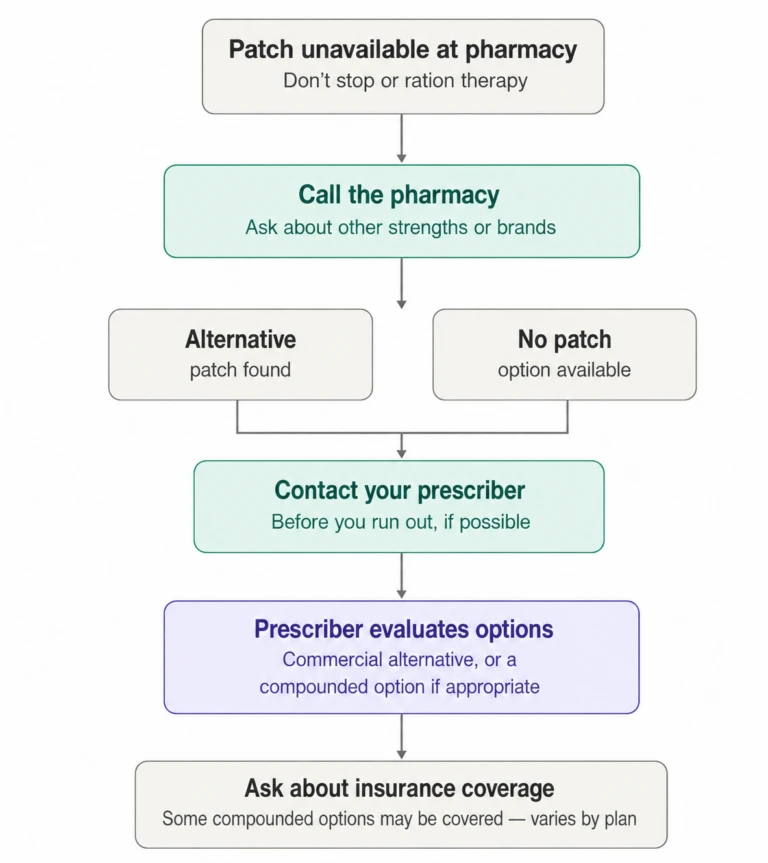
If your estradiol patch is unavailable, do not stop or change therapy without guidance. Ask the pharmacy about other manufacturers, strengths, or patch schedules. If no appropriate patch is available, contact your prescriber to review FDA-approved alternatives or whether a patient-specific compounded option may be appropriate.
What patients and prescribers can do when a familiar hormone therapy suddenly becomes hard to find
Over the past year, many patients who rely on estradiol transdermal patches have heard a frustrating phrase at the pharmacy counter: “It’s on backorder.” For someone using hormone therapy to manage hot flashes, night sweats, sleep disruption, mood changes, genitourinary symptoms, or bone-health concerns, that message can feel more than inconvenient. It can feel destabilizing.

At ScriptWorks in Walnut Creek, California, we keep a running total of how many patches are currently available at any time.
As a compounding pharmacist, I see both sides of this shortage. I hear from patients who are worried about losing symptom control, and I hear from prescribers who are trying to keep care consistent while commercial products move in and out of availability. None of this is meant to replace what happens between a patient and their prescriber. It’s meant to help both sides know what’s actually going on when a familiar medication disappears from the shelf, so nobody makes a rushed decision out of panic.
Why the Shortage Feels So Disruptive
Estradiol patches are popular because they deliver medication through the skin, provide steady hormone exposure, and avoid first-pass metabolism through the liver. For many patients, a patch is simple, predictable, and well-tolerated. When that specific delivery system becomes unavailable, “finding some estrogen” isn’t really the problem. Keeping the dose, route, symptom control, and safety profile right for that particular patient is.
Shortage reports have varied by source and by product, but the pattern has been consistent for roughly 12 to 18 months now: supply comes back for a few weeks, then tightens again.
The American Society of Health-System Pharmacists has listed multiple estradiol transdermal patch products affected by backorder or allocation, including products from several manufacturers. At the same time, other sources note that availability differs by brand, strength, and region. This isn’t limited to one product line — both once-weekly and twice-weekly patches have been affected, across strengths. One pharmacy might be out of a twice-weekly patch while another still has a once-weekly version, a different strength, or a different manufacturer.
That variability is confusing. Patients often hear “no patches are available,” when what’s actually true is closer to “your exact product isn’t available from our current supplier today.” Those are two different problems — and the second one usually leaves more room to work with before therapy actually gets interrupted.
How a Compounding Pharmacist Thinks About the Problem
When May Compounded Estradiol Be Considered?
My first question isn’t “What can we compound?” It’s “What FDA-approved option can keep this patient safely covered?”
If an available commercial estradiol patch, gel, spray, tablet, or vaginal product is appropriate, that option should be discussed with the prescriber first. Commercial products have standardized manufacturing, labeling, and clinical data that compounded preparations do not have in the same way.
Compounding may be considered when a prescriber identifies a patient-specific clinical need that isn’t met by an appropriate available FDA-approved product. That may involve an allergy or sensitivity to an excipient, difficulty tolerating an available dosage form, a need for an individualized strength, or a temporary access gap that requires prescriber-directed planning. In those situations, a compounding pharmacy can collaborate with the prescriber to prepare a patient-specific medication under applicable state and federal requirements.
A compounded estradiol preparation isn’t the same thing as a manufactured patch, and patients shouldn’t treat it that way. It may deliver estradiol differently, absorb differently, be dosed differently, and need different monitoring. A compounded cream isn’t interchangeable with a patch on a milligram-for-milligram or microgram-for-microgram basis.
Practical Steps for Patients
- Do not stop or ration therapy without guidance. Wearing a patch longer than prescribed, cutting a patch, or skipping doses can lead to symptom recurrence or unpredictable dosing.
- Ask the pharmacy specific availability questions. Instead of asking only whether “estradiol patches” are available, ask whether any manufacturer, strength, or once-weekly versus twice-weekly option can be ordered.
- Call before you run out. Shortage situations are easier to manage with time. Contact your pharmacy and prescriber when you have at least one refill cycle remaining, if possible.
- Keep your prescriber involved. Route changes, dose conversions, and hormone-therapy adjustments should be individualized based on your symptoms, medical history, uterus status, risk factors, and therapy goals.
- Ask about a backup plan. A written plan can reduce stress if your usual product is unavailable again next month.
Practical Steps for Prescribers
When patients report an unavailable estradiol patch, consider writing prescriptions with some clinically appropriate flexibility, such as allowing substitution among equivalent manufacturers when appropriate. If changing route or dose form, provide clear instructions and follow-up parameters so the patient and pharmacist are not left guessing. Patients should not cut or alter a patch unless the prescriber and pharmacist confirm that doing so is appropriate for that specific product.
For patients who may benefit from compounded therapy, include the clinical rationale, target dose, dosage form, directions, and monitoring expectations. Collaboration is especially important because compounded hormone preparations require careful counseling about application site, timing, storage, expected onset, and what symptoms should prompt follow-up.
What Compounding Can Fix — and What It Can't
Compounding may be valuable when it solves a specific patient problem. It allows customized strengths, avoids certain inactive ingredients, or provides an alternate dosage form when commercially available options are not workable. During a shortage, that flexibility may help maintain continuity of care for selected patients under prescriber supervision.
But compounding isn’t a shortcut around clinical judgment, either. Nobody should present a compounded preparation as safer, stronger, more “natural,” or equivalent to an FDA-approved patch, because it isn’t any of those things by default. It’s an individualized option that may make sense once a patient and prescriber understand the tradeoffs.
Cost is worth asking about too. Insurance covers some compounded alternatives, though coverage varies by plan and isn’t guaranteed, so it’s worth a call to check rather than assuming either way.
ScriptWorks’ pharmacists are available to talk through compounded options with prescribers, patient by patient, during this shortage. We don’t publish a general conversion chart, since the right dosing really does depend on the individual patient and whatever’s actually available that week. Prescribers can call the pharmacy to work through a specific case.
The Bigger Lesson
The estradiol patch shortage has shown how fragile medication access can be, especially for therapies that affect daily quality of life. It’s also a reminder of what pharmacists are actually for. Community pharmacists, compounding pharmacists, and prescribers all have a piece of this: figuring out what’s realistically available, flagging safe alternatives, and keeping the conversation patient-specific instead of generic.

If your estradiol patch is unavailable, skip the panic and just call someone. Call your pharmacy, call your prescriber, and ask what’s actually available today and whether compounding has a legitimate place in your situation. A compounding pharmacist at ScriptWorks can walk through what your options look like.
Contact ScriptWorks and your prescriber before your current patch supply runs out. Our pharmacists can review current availability and collaborate with the prescriber when a patient-specific compounded option may be appropriate.
Patients should consult their licensed healthcare provider before starting, stopping, or changing hormone therapy. Compounded medications are not FDA-approved and are not equivalent to, or interchangeable with, manufactured products; they are prepared only pursuant to a valid patient-specific prescription and in collaboration with a licensed prescriber.