


Author: Bob Brensel | President, Pharmacist | ScriptWorks
Bob Brensel, RPh, earned his Pharmacy Degree at University of the Pacific in Stockton, California in 1980. Former California Pharmacists Association’s Award Winner for Recognition of Outstanding Achievement in Compounding Pharmacy. Read More →
Compounded Testosterone Cream for Women in Menopause and Perimenopause
Changes in sexual desire can be a personal and sometimes unexpected part of perimenopause and menopause.
About 5 million California women are ages 40–64
California has approximately 5 million women between ages 40 and 64, the age range in which many women experience perimenopause, menopause, or early postmenopause.
Source: CHBRP.org
Some women notice a gradual change. Others feel that an important part of their identity or relationship has shifted. For some, the change causes little concern. For others, it may create meaningful personal distress.
When low sexual desire continues and causes distress, a licensed healthcare provider may evaluate whether the patient has hypoactive sexual desire disorder, commonly called HSDD. After considering the patient’s health history, symptoms, medications, relationships, emotional well-being, and other possible contributors, the prescriber may discuss whether testosterone should be considered.
What is testosterone?
Testosterone is often associated with men, but women also naturally produce testosterone in the ovaries, adrenal glands, and other tissues.
Testosterone is involved in several physiological processes, including aspects of sexual desire and sexual response. However, the relationship between a woman’s testosterone level and how she feels is complex.
Two women with similar testosterone levels may have very different experiences with desire, arousal, comfort, energy, mood, and overall well-being. This is why a laboratory result cannot be viewed separately from the patient’s symptoms and health history.
What is compounded transdermal testosterone cream?
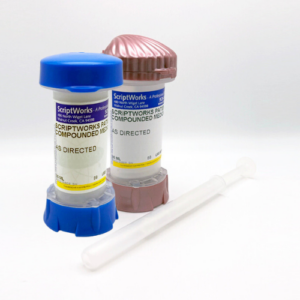
Compounded testosterone cream is a prescription medication prepared for an individual patient according to a licensed prescriber’s order. Transdermal testosterone differs from oral options as it is dosed into the microvascular circulation directly through skin so there is no first-pass hepatic transformation or deactivation of the testosterone.
Drug compounding generally involves combining, mixing, or altering ingredients to prepare a medication for an individual patient’s identified medical need.
For compounded transdermal testosterone cream, a prescriber may specify:
- The amount of testosterone in each gram or milliliter
- The amount delivered by each click, pump, or measured dose
- The type of topical base
- The intended application site
- Ingredients that should be included or avoided
- Patient-specific application instructions
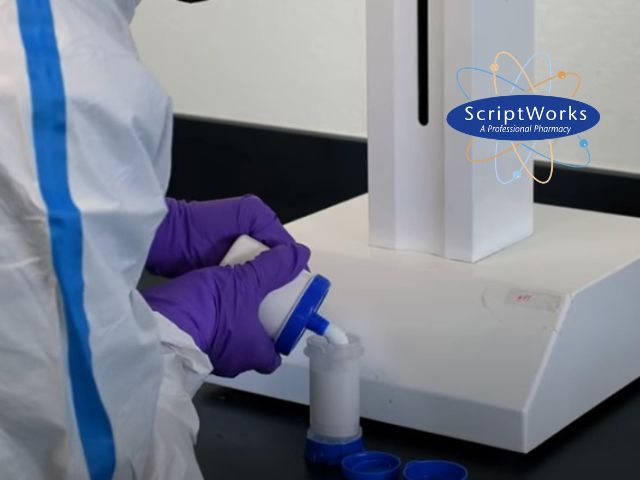
Compounded prescriptions may serve an important role for certain patients whose identified needs cannot be met by an available mass-produced, commercially available medication. Poor compounding practices may result in concerns such as contamination, incorrect potency, or inconsistent quality. It’s important to choose an experienced hormone replacement therapy compounding pharmacy, like ScriptWorks.
Why might a prescriber consider compounded testosterone cream?
A prescriber may consider a compounded cream when a patient requires an individualized preparation.
A low‑dose topical cream (e.g., 2 mg/gm) is attractive because:
- It can be titrated more flexibly (dose up or down).
- It avoids spikes in systemic levels seen with injections or high-dose oral formulations.
- The skin acts as a “reservoir,” enabling slow absorption.
- It’s potentially more convenient and less invasive.
However, dosage consistency, absorption variability (skin thickness, site, hydration), and transfer risk (to others via skin contact) are important practical challenges.
What does the scientific evidence support?
The strongest evidence for testosterone use in women relates to postmenopausal women with HSDD.
“Transdermal testosterone is effective in the treatment of hypoactive sexual desire disorder (HSDD), documented in multiple, well-powered randomized clinical trials with demonstrated high levels of safety.”
HSDD generally describes a persistent or recurring reduction in sexual desire that:
- Causes personal distress
- Is not better explained by another medical condition
- Is not primarily caused by a medication
- Is not better explained by relationship concerns or psychological factors
Not every woman with lower desire has HSDD. A woman may experience less sexual interest without being distressed by it.
Supporting Studies
A clinical trial published in The New England Journal of Medicine evaluated transdermal testosterone in more than 800 postmenopausal women with HSDD who were not using estrogen.
One testosterone-dose group reported a positive difference in satisfying sexual experiences compared with placebo.
2019: Systematic review and international consensus
A 2019 systematic review analyzed 46 reports from 36 randomized trials involving 8,480 participants.
Among postmenopausal women with low sexual desire and associated distress, testosterone was associated with modest average changes in several sexual-function measures.
What should be evaluated before prescribing?
Sexual desire can be influenced by many biological, psychological, interpersonal, and social factors.
A thoughtful evaluation for a woman in menopause may include:
- Whether the change causes personal distress
- Vaginal dryness or discomfort during sex
- Genitourinary syndrome of menopause
- Sleep quality
- Fatigue
- Stress or major life changes
- Depression or anxiety
- Relationship concerns
- Body-image concerns
- Medication effects
- Thyroid or metabolic conditions
- Menopausal hormone use
- Pregnancy potential during perimenopause
- The patient’s expectations and personal goals
What about compounded testosterone cream during perimenopause?
Perimenopause is the transition leading up to menopause. During this time, menstrual cycles may become irregular, hormone levels may fluctuate, and pregnancy may still be possible.
Before considering compounded testosterone cream for a perimenopausal patient, a prescriber may evaluate:
- Pregnancy potential
- Contraception
- Menstrual changes
- Vaginal discomfort or pain
- Sleep and stress
- Mood
- Medication effects
- Relationship factors
- Other possible causes of low desire
Testosterone should not be used during pregnancy. A patient who may become pregnant should discuss pregnancy prevention and what to do if pregnancy is suspected with her prescriber.
The role of hormone testing
Hormone testing may provide useful information as one part of a broader health assessment.
Before considering testosterone, a prescriber may request testing to establish a baseline, identify an unexpectedly elevated testosterone level, evaluate sex hormone-binding globulin, or support monitoring after use begins. Clinical guidance recommends measuring total testosterone before prescribing and repeating it during treatment to help reduce the possibility of excessive exposure.
ScriptWorks at-home hormone testing kits
ScriptWorks offers at-home hormone testing kits that use saliva samples, dried blood-spot samples, or both, depending on the selected panel.
At-home collection may provide a simple and convenient way to gather additional information that can be shared with a qualified healthcare practitioner. Depending on the kit selected, testing may include certain sex hormones, adrenal markers, or other health-related measurements.
These results may contribute one part of a more complete health picture when considered alongside:
- Symptoms
- Menstrual and menopause history
- Current prescriptions and supplements
- Sleep and stress
- Sexual-health concerns
- Medical conditions
- Other laboratory testing
What monitoring may be recommended?
The monitoring plan should be determined by the prescriber based on the individual patient.
It may include:
- Total testosterone before prescribing
- Sex hormone-binding globulin
- Liver-function testing
- A lipid profile
- Repeat testosterone after starting
- Repeat testing after a dose change
- Periodic testing once the patient is stable
- Review for acne or oily skin
- Review for facial or body-hair changes
- Review for scalp-hair thinning
- Review for voice or genital changes
- Assessment of whether the patient has experienced a personally meaningful change
ISSWSH guidance recommends checking total testosterone approximately three to six weeks after initiation and after changes in dose, followed by periodic monitoring once levels are stable. Please note that it is common for topical hormones, like testosterone or Progesterone not to show up in serum testing, as when applied topically they go right to the tissues, not hanging around in venous blood. .The rise in hormones can be measured in capillary blood, saliva and Dutch tests. (see study comparing topical progesterone serum levels in saliva, blood spot, Dutch, Serum in Menopause 2013).
How soon may a patient notice a change?
Clinical guidance suggests that some women may begin noticing changes after approximately four to eight weeks. A fuller assessment may occur at approximately 12 weeks.
Experiences vary, and a meaningful change is not guaranteed.
When a patient has not experienced a meaningful change after a monitored three-to-six-month trial, guidance generally recommends discontinuing testosterone and reassessing the diagnosis and other possible contributors.
What side effects may occur?
Possible androgen-related effects may include:
- Acne
- Oily skin
- Anger
- Increased facial or body hair
- Scalp-hair thinning
- Irritation at the application site
Short-term clinical trials have not shown a consistent pattern of serious adverse events when testosterone concentrations remained within physiological female ranges.
How to Apply Compounded Testosterone Cream
Compounded hormone creams are frequently dispensed using metered applicators like Topi-Click, which release a fixed volume per activation.
- 1 click = 0.25 mL
- 2 clicks = 0.5 mL
- 3 clicks = 0.75 mL
- 4 clicks = 1 mL
Even small variations in applied volume may influence systemic exposure. Therefore, prescribers determine both the formulation strength and how dosing will be monitored over time.

ScriptWorks video tutorial
This tutorial provides general measuring and application guidance.
Frequently Asked Questions
What does “transdermal testosterone” mean?
Transdermal testosterone is applied to the skin and absorbed through it. Creams and gels are examples of transdermal dosage forms. The amount absorbed may vary depending on the formulation, concentration, application site, skin condition, and how the product is used.
Why might a prescriber consider the transdermal route?
Clinical guidance generally favors transdermal administration over oral testosterone when testosterone is considered for women. Transdermal use may allow relatively small amounts to be applied while avoiding the unfavorable lipid changes associated with oral testosterone in clinical studies.
How quickly may a patient notice a change?
Some clinical guidance suggests that changes may begin after approximately four to eight weeks, with fuller assessment around 12 weeks.
Individual experiences vary, and a meaningful change is not guaranteed.
Where is hormone cream applied?
When asking how to apply BHRT cream or where to apply it, commonly recommended regions include:
- Inner forearm
- Inner thigh
- Abdomen
These areas provide:
- Relatively thin skin
- Adequate surface area
- Discreet coverage to reduce transfer
Rotating within the same general region may help minimize irritation while maintaining absorption consistency. Apply BHRT cream only to clean, dry, intact skin. Please note: It’s not recommended to apply BHRT cream to inner forearms if the patient is around children or babies.
What are ScriptWorks at-home hormone testing kits?
ScriptWorks offers kits that allow patients to collect saliva samples, dried blood-spot samples, or both at home, depending on the selected panel.
Testing may provide additional information that can be shared with a healthcare practitioner.
Can testosterone cream transfer to someone else?
Yes. Medication remaining on the skin may transfer through direct contact.
Washing the hands, allowing the site to dry, covering it as directed, and avoiding direct contact with children, partners, pregnant individuals, and pets may help reduce unintended exposure.
Can a woman use transdermal testosterone during pregnancy?
Testosterone should not be used during pregnancy. A perimenopausal patient who could become pregnant should discuss contraception and what to do if pregnancy is suspected with her prescriber before use.
This article is intended for educational purposes only. It does not diagnose a health condition, recommend medication, establish that compounded testosterone is appropriate for any individual, or replace advice from a licensed healthcare professional. Compounded medications are not FDA-approved. Testosterone is available only by prescription and is a controlled substance.
References
- Buster, J. E. (2010). Transdermal menopausal hormone therapy: delivery through skin changes the rules. Expert opinion on pharmacotherapy, 11(9), 1489–1499. Link
- Davis, S. R., Baber, R., Panay, N., Bitzer, J., Cerdas Perez, S., Islam, R. M., Kaunitz, A. M., Kingsberg, S. A., Lambrinoudaki, I., Liu, J. H., Parish, S. J., Pinkerton, J. V., Rymer, J., Simon, J. A., Vignozzi, L., & Wierman, M. E. (2019). Global consensus position statement on the use of testosterone therapy for women. The Journal of Clinical Endocrinology & Metabolism, 104(10), 4660–4666. Link
- Davis, S. R., Moreau, M., Kroll, R., Bouchard, C., Panay, N., Gass, M., Braunstein, G. D., Hirschberg, A. L., Rodenberg, C., Pack, S., Koch, H., Moufarege, A., & Studd, J. (2008). Testosterone for low libido in postmenopausal women not taking estrogen. The New England Journal of Medicine, 359(19), 2005–2017. Link
- Du, J. Y., Sanchez, P., Kim, L., Azen, C. G., Zava, D. T., & Stanczyk, F. Z. (2013). Percutaneous progesterone delivery via cream or gel application in postmenopausal women: A randomized cross-over study of progesterone levels in serum, whole blood, saliva, and capillary blood. Menopause, 20(11), 1169–1175. Link
- Fooladi, E., Reuter, S. E., Bell, R. J., Robinson, P. J., & Davis, S. R. (2015). Pharmacokinetics of a transdermal testosterone cream in healthy postmenopausal women. Menopause, 22(1), 44–49. Link
- Grober, E. D., Garbens, A., Božović, A., Kulasingam, V., Fanipour, M., & Diamandis, E. P. (2015). Accuracy of testosterone concentrations in compounded testosterone products. The Journal of Sexual Medicine, 12(6), 1381–1388. Link
- Islam, R. M., Bell, R. J., Green, S., Page, M. J., & Davis, S. R. (2019). Safety and efficacy of testosterone for women: A systematic review and meta-analysis of randomised controlled trial data. The Lancet Diabetes & Endocrinology, 7(10), 754–766. Link
- Parish, S. J., & Hahn, S. R. (2016). Hypoactive sexual desire disorder: a review of epidemiology, biopsychology, diagnosis, and treatment. Sexual medicine reviews, 4(2), 103–120. Link
- Parish, S. J., Simon, J. A., Davis, S. R., Giraldi, A., Goldstein, I., Goldstein, S. W., Kim, N. N., Kingsberg, S. A., Morgentaler, A., Nappi, R. E., Park, K., Stuenkel, C. A., Traish, A. M., & Vignozzi, L. (2021). International Society for the Study of Women’s Sexual Health clinical practice guideline for the use of systemic testosterone for hypoactive sexual desire disorder in women. The Journal of Sexual Medicine, 18(5), 849–867. Link